Monday, August 18, 2025

Rhodes Stories

As our vessel approached Rhodes port on a hot day, I wondered where Collossus of Rhodes stood. I tried to imagine we were passing between the legs of Helios while shades of folded sails and swinging ropes were sweeping the floorboards, and cries of ancient deckhands are heard for a safe passage. 

We saw the walls of Rhodes Old Town and minarets of two mosques afar, Süleymaniye Mosque and Ibrahim Pasha Mosque decorating the ancient skyline. 

We rented a renovated house close to St John’s Gate at the end of Pithagora Lane. Rhodes Old Town is UNESCO listed. Decscendants of Greek and Turkish ancestors who made this place home for many centuries still live in Old Town. As you walk by on narrow cobblestone alleys you may notice some house-doors are left open, from where murmurs of old stories escape along with mist. Sometimes a motorcyclist pass by, but otherwise in this part of the town you will be breathing the past.  


Upstairs, I sit on a small sofa in a small hall and fixed my gaze outside. The balcony door has windows from ground to ceiling. Outside there was a tiny Juliette balcony, on it a tiny table with a green plant in a terracotta pot and tiny chairs on each side. Beyond I see ancient walls of a desolate house waiting to be renovated. Behind that there are city walls close to St. John’s gate. I hear constant buzzing of cicadas singing through intense heat, taking me to what this place looked like five hundred years ago. 

----

As you walk down Pithagora Lane towards Hippocrates Square at noon you will see more and more tourists. When you reach the square suddenly the magic is lost; you will be surrounded by hundreds of sweaty tourists with bad sunburns. Phones are in hand or mounted on selfie sticks, harsh daylight is casting ugly shades everywhere, everybody is in Instagram or TikTok, or Facebook, or WhatsApp or GodKnowsWhat recording mode, desperate to show off they are having good time, while makeups, fake eyelash glues and ice creams are melting fast in thirty four degrees Celsius. 

Tourists are drinking coloured drinks, taking selfies for most bizarre looking photos, standing next to store entrances where the cold AC air blows. 

---

When the sun sets and magic hour begins, crowds get most intense, barkers appear in restaurant fronts. Tourists appear strolling in better outfits, summery and light coloured, suitable for dinner; all had showers, young women and young men suntanned, glance at each other briefly, no doubt they are now feeling good with a prospect of romance sparkles their eyes, everybody is in their better selves, insecurities were shelved, sicknesses and world’s troubles were forgotten just for tonight. 

We dined in New Town then came back to Old Town late at night. It was busier than daytime. While waiting for the girls shopping in a gift shop on Socratous Street, I threw myself to a shop front across the street to avoid crowds. I noticed it was a jewellery shop with bright lights. Realising I was blocking the shop window, I moved aside. The owner acknowledged my gesture and we started to talk. 

- Waiting for the girls, my wife and my sister, they are shopping there. Sorry. I didn’t want to obstruct your shop window. 

- Yes, you’d better. 

- My name is Ergun. Yours?

- Nikos. 

- We love Rhodians’ hospitality. We had troubles in the past. But things are better now. With relaxed visa rules, trade between Marmaris and Rhodes flourished. 

- We fought for nothing. You and I are normal, politicians are not. The shop owner there and there (indicating shops) are Turks. We are friends. We eat and drink together. 

- Yes. You are right. Politicians are not normal. 

----

We went to Museum of Modern Greek Art to see a photography exhibition, Ara Güler’s Anatolia in Colour. 

After visiting the exhibition we chatted with a young guy whom we bought the tickets from. Yannis wants to be a chef. He recommended a few authentic Greek tavernas in the southern part of the city, outside St. George’s gate. 

In the evening we went home, freshened up, then walked up the St John’s gate and passed to the south. We walked fair bit at dusk with a feeble white light pouring from my cell phone’s Google Maps. 

We were in a working class suburb. We can tell from clothing lines, worn off supermarket store signs and black garbage bags overflowing large bins on the pavement. Not that this was off putting; I like experiencing real lives of real people. When we reached Alex. Ipsilantou lane. There it was Μια Πιρουνιά (A Fork). The entrance was modest, it could have been a garage, or a warehouse, nothing suggested there was a charming, old school taverna inside. 

Alekos, the host of “A Fork” taverna greeted us. He was a sympathetic man in his seventies. He showed us a group of black and white photographs of his ancestors hung on the wall behind him. There was a beautiful girl image with sad eyes. Alekos told us she was starved to death during Nazi occupation.

Inside, it was simply a medium size hall with walls painted in pink, featuring a clock going in reverse, anecdotes written on mirrors, little pots with colourful little flowers, more anecdotes written on blackboards, some in Greek, some in English, like “The problem with the world is everyone is a few drinks behind - Humphrey Bogart”. 

Inside the hall, there was a stage near the entrance. The rest of the hall had pale green wooden tables, around them there were pink and yellow wooden chairs. 

The pale green roof was covering half of the hall length from the stage end. The other half was  just a skeleton of beams supporting the walls. You could see the sky, dark blue, deep and sad, and stars are sprinkled on it. 


It was a balmy evening with aniseed breeze and unsung songs. 

We had delicious food, octopus, calamari, salad, cheese balls, fried cheese with honey and sesame seed and uzo. 

Two musicians took stage. One was playing a guitar and the other one, a slim guy with glasses, a bouzouki. Ballads of Dodecanese Islands filled the air. The slim musician played Zülfü Livaneli’s “kardeşin duymaz el oğlu duyar” in Greek. I greeted him. I tapped my right hand on my chest; he did the same. 

At the door we thanked Aleko; he had the waitress took our photograph with him in memory of the night. 

----

I saw him sitting on a stone wall under the shade of a tree. He was a dapper man, in his eighties perhaps, holding a rosary in his hands, with blue trousers, a light blue shirt and a blue fedora hat. He greeted me (his name was Şahap) and we started to talk in Turkish. 

- I am ninety years old. 

- You don’t look like ninety. 

- My ancestors came with Yavuz Sultan Selim from Karaman. I’ve seen so many things. Now everybody is gone. 

There was a silence. 

- Do you think Azrael discriminate when your time comes?

- Err.. I don’t know.

- No it won’t. It won’t give you a minute if you ask for a minute. It will take you right away. Who do you think then is the most welcoming?

- God?

- No. It is the Mother Earth. It will take you to its bosom whether you are a Jew, a Christian or a Muslim. 

Şahap was looking for something in his shirt’s pocket. He pulled two passport size black and white photographs. One a young handsome man in his thirties (it was him), and another one a beautiful woman. 

- It has been many years since I lost her. I have been living here all by myself. I don’t know where I want to be buried. 

- But don’t you have children, grandchildren?

- I do but I live alone and I’m alone. 

---

When we left Rhodes, once again Mediterranean Sea embraced us. Harsh winds were whistling through the upper deck while white foams were kissing dark blue waves. In them hundreds of stories were being retold, like sirens’ whispers they sounded unintelligible as they mixed with each-other and as we left beautiful Rhodes behind.  

---


Tuesday, August 29, 2023

The Hagia Sophia

 I was standing before the altar in the Hagia Sophia. I looked up and saw two long curtains coming down from the apse ceiling, partially covering up mosaics depicting Virgin Marry and the Christ Child. There is solemn sadness in their gaze, visible from the gap between the curtains. The curtains were installed when the complex was converted from a museum into a mosque in 2020.

Two calligraphic wood-panel medallions are located within the interior nave of the apse. They bare names of Allah and Muhammed.

The crowd beneath the dome, tourists, faithful and unfaithful alike, were looking up and around in awe. I wondered how many of Christian and Muslim visitors realised how absurd it was to be unified under one place of worship designed and redesigned to revere different versions of conceptually the same god.

The Hagia Sophia was built as a church building in 537 AD and remained a mosque from 1453 until 1931, when it was closed to the public for four years. It was re-opened in 1935 as a museum under the secular Republic of Turkey, and the building was Turkey's most visited tourist attraction as of 2019. In July 2020, the Council of State annulled the 1934 decision to establish the museum, and the Hagia Sophia was reclassified as a mosque. The decision to designate Hagia Sophia as a mosque was highly controversial and drew condemnation from the Turkish opposition, UNESCO, the World Council of Churches and the International Association of Byzantine Studies, as well as numerous international leaders. 1

Friday, August 18, 2023

The patio

The sea breathes. On this corner of the patio there is always a cool breeze even at the hottest time of the day when the air is humid and thick elsewhere. 

He is surrounded by a side yard where on his right there is an orange tree, a lemon tree, a pomegranate tree and an olive tree and on his back a narrow backyard fenced by shrubs and beyond those another backyard with a fig tree and a desolate white house. The neighbours are old and not visiting the desolate house anymore. The fig tree, left to grow old naturally shares a large pale ground with a gigantic cactus plant. The figs on the branches are smallish and they are not tasty and on the ground there are rotten figs. On his left, there is a small invisible frame enclosed by the patio and white walls. From that in the late afternoon he watches the sun setting over the sea beyond the house and shrubs, and bougainvillaea. 

He watches a wasp with a long tail buzzing around cavities under the patio roof, sampling then moving along. From farther he hears a cuckoo singing.

The old house is quiet now. It had seen days when elders were alive, and sons and daughters were married and just had their own. The house was abuzz with chatter and people were walking up and down the stairs, and there were sounds of cutlery and tea brewing. 

The cuckoo stops singing. He is resting in his old chair. His eye lids close.

Friday, August 11, 2023

Artificial Neural Networks

It was 1990, the second year in Sydney. I was working for a fintech startup buzzing in a small stylish office in the Little Buckingham Street, Surry Hills. The Little Buckingham was a charming leafy street with cottages and warehouses, occupied by fashion ateliers, art galleries and alike. 

The Internet did not exist, mobile phones looked like bricks, cheap Taiwanese made IBM personal computer clones with DOS operating system were emerging.

Windows 2.0 was released two years earlier in 1987, and Lotus123 was the most amazing spreadsheet application we had ever known. 

Our company had a joint venture with the PC manufacturer Olivetti; we were using several Olivetti machines in the office. Olivetti had a modern office on the William Street. There, we carried out a demo integration of our financial hardware with a banking application. 

OCR (Optical Character Recognition) technology had been available since 1960s. I was integrating OCR cheque readers to our products. These motorised machines captured cheques and read text printed on them. However they were incapable of resolving handwriting. 

Lunch break starts. I used to walk down to Broadway through a long pedestrian underpass under the Central Station. At the time Broadway was bustling with a cosmopolitan crowd. Long passed its heydays, it had Sydney University and UTS students, bookstores, Chinese takeout shops, sex-shops, antique shops selling world war memorabilia, helmets, medals and bayonets, shops selling tents, hunting equipment, knives and guns. A bookstore called Coop sold discounted books for uni students. 

On a sunny afternoon I was strolling inside the Coop bookshop. I was looking for an interesting book. I picked up a hardcover on neural networks. 

I was curious if computers could recognise handwriting using Artificial Neural Networks (ANNs.) 

ANNs imitate biological neural networks of a human brain. I found a book that had variety of examples on the subject matter. 

Initially ANNs were constructed using Digital Signal Processing (DSP) hardware. Later on Graphical Processing Unit (GPU) hardware took over. 

This was my first glimpse at the world of AI, without knowing ANN was the foundation of AI. 

You could develop, I thought, an ANN computational model that would accurately recognise handwritten characters. It should be able to differentiate similar characters, say ‘1’ from ‘7’, handling nuances in handwriting. This way you could feed a handwritten number on a bank cheque to an ANN hardware and resolve its value. 

Suddenly it occurred to me, an ANN on a chip is no different than its biological counterpart in human brain. 

Like you teach a child how to write, you need to teach the ANN how to read handwriting. This is called “supervised learning”. 

Teaching an ANN hardware involves scanning the handwriting and feeding the information to an ANN processor. The ANN outputs what it recognises. A human agent verifies (supervises) if the ANN’s recognition is correct or not, which is then fed back to the ANN. Verification would make the ANN to re-adjust its internal “weights” on the patterns it “saw”. The cycle continues until the ANN gets sufficiently better in recognising all characters, in all varieties of handwriting. 

The more you expose subjects (child or ANN) to diverse sets of handwriting, the better they would become. 

ANNs or humans initially need supervision, but at a point they could keep learning unsupervised and differentiate not only their own (supervised) handwriting but others’. This is called self-learning. 

There may be illegible handwritings. Those may have a digit or two impossible to work out. In those circumstances an ANN would be no better than a human, it will fail. 

An ANN would be vastly accurate in its reading than a human’s, if it was trained hard with much larger and more diverse datasets. Nevertheless it may produce inaccurate results no matter how hard it was trained and how small the chances are. On a bad day even Einstein would have failed. 

As I read the neural networks book I wanted to run experiments and verify my understanding. But I couldn’t go pass thought experiments. Computers with GPUs did not exist then. 

Twenty years later, in 2010, in a different company, we kickstarted an anomaly detection project that would pinpoint fraudulent transactions recorded by our Payments product. I worked with a data scientist who developed supervised ML algorithms. I implemented those algorithms using a statistical analysis programming language called R.

The problem of inaccuracy remained. An AI model may fail in peculiar ways no matter how hard it was trained and fine tuned. Sometimes we had false positives (a normal transaction was flagged as anomaly), or we had false negatives (a fraudulent transaction was treated as normal.) With fine tuning, accuracy rate could be improved, but it could never reach 100%. 

ChatGPT is a chatbot, based on an AI-powered language model developed by OpenAI, capable of generating human-like text based on context and past conversations1

Agent 007 decides to battle against an eccentric scientist, Dr. No, who is determined to ruin the US space programme.

On a beautiful day in mid 1960s my older brother decided to elevate me from being a useless little brat to a more respectable brother status with no reason. We went to a stylish movie theatre in the main boulevard and watched Dr. No. 

I was mesmerised by Dr. No. I wondered how come Dr. No, the coolest villain ever, be utterly ruthless and in control at the same time. In the end Dr. No’s world domination plans were spoiled by Agent 007; Dr. No attempted to stop him, but fell into the reactor pool, boiled to death.

In Asimov’s Foundation and Empire (1952) there is a villain called the Mule - my all time favourite villain. This guy could telepathically read and manipulate anybody’s mind in the entire universe and make them scared of him. This way he could take over planets at rapid pace. Next to him, Dr. No looked like a jester. 

It may be possible for an AI bot to behave like a super-powerful mind reading bully. Welcome MuleGPT. 

When OpenAI released the large language model GPT-4, in March 2023, it was good at identifying prime numbers. When the AI was given a series of 500 prime numbers and asked whether they were primes, it correctly labeled them 97.6 percent of the time. But a few months later, in June, the same test yielded different results. GPT-4 correctly labeled 2.4 percent of the prime numbers. AI researchers prompted it with—a complete reversal in apparent accuracy 2.

AI enthusiasts speculated. With GPT-4, it is possible that the OpenAI developers were trying to make the tool less prone to offering answers that might be deemed offensive or dangerous. These changes required fine-tuning, ie. training the engine with a different set of datasets. 

Fine-tuning could have induced side effects in prime number detection, akin to random mutations causing undesirable effects in biology. 

As a consequence of mutations the gene may produce an altered protein, it may produce no protein, or it may produce the usual protein. Most mutations are not harmful, but some can be. A harmful mutation can result in a genetic disorder or even cancer.

Hence, it is possible that MuleGPT, an AI powered language model chatbot, may unexpectedly change its behaviour and become dumber, as a result of fine tuning. 

If we are lucky, MuleGPT may decide to leave the planets it conquered and jump to a blackhole for a swim. 

Thursday, August 3, 2023

Datça - the last frontier to Eden

I am at a modern coffee shop in Datça, sitting inside, behind a large, stylish ventilator. The shop’s name sounds promising, “The Coffee Grinder”. 

I am reading a Turkish book written by Özgül Tuzcu and Ezgi Kurt New Life in a Seaside Town, interviews with 60 individuals who settled in Datça.

I order a small cup of Americano. The coffee is not freshly ground and it is served boiling hot, leaving a veneer of plastic-cardboard flavour in my mouth. They serve coffee in disposable cups here.

Last time I visited Datça, it was in 2018, five years ago. 

Since then the town has grown. There are more townhouses built outside the town centre. Locals are concerned with environmental impact of new building projects. Builders leave not enough space between buildings. Diminishing air corridors and climate change are suffocating Datça.

Datça locals are worried about their town is in the footsteps of  Bodrum. Once a small fishing village, Bodrum lost its charm long time ago. It turned into an overpopulated, overdeveloped, congested and polluted mega town, a familiar tale for many coastal towns all around the world.

In the last half a century, increased global wealth, the rise of Internet and cheaper air travel ramped up tourism by 56 times (https://ourworldindata.org/tourism.) Before the pandemic nearly 4 million tourists travelled the world everyday.

Datça needs growth to sustain itself whole year around. 

Is it possible to grow a seaside town’s economy in a sustainable fashion, by avoiding over-tourism? 

How would you engage with a partisan government who would pour money into an opposition town to improve its roads and infrastructure, without expecting a hefty return for itself?

On the upside Datça has a well educated population of Young Turks, entrepreneurs who share a strong ambition to maintain what Datça is known for, a lovely, clean, secluded, eco-friendly town. 

Streets are wide and clean. Recycling bins are available, though not consistently. Plastic poles are cleverly used to separate lanes. This works better than painted lane markers that are sometimes disregarded in Türkiye. 

On the downside, current economic hardship Türkiye is going through had an impact. It is August, but our hotel is operating at one third of its peak capacity. Recent mega price increases (e.g. petrol) caused all prices to spiral out of control, cutting back tourists, local and foreign alike. This is a recession and it is hurting both locals and tourists. People who visit Greek islands say “everything is cheaper and better quality over there”.

Other problems Datça is facing are long standing ones; bad roads, stray dogs, drivers disregarding pedestrians at crossings. 

The heat is unbearable. I think cossy Parisian coffee shops, small tables and small chairs are misfits here. 

I now move to a large breezy tea garden, protected by shades of thick tree canopies overlooking to an open plaza. 

Datça is breathing again.

Turkish References 

Sahil Kasabasında Yeni Bir Hayat, Datça’ya yerleşen 60 kişiyle söyleşi, Özgül Tuzcu, Ezgi Kurt 

  • sayfa 30: paragraf: Datça nasıl değişiyor sence?
  • sayfa 125: paragraf: Peki sorunlar yok mu?

Saturday, July 22, 2023

Demise of wall clocks

In the foyer where the giant teddy bear with its lifeless gaze is watching crowds below, parents take pictures of their children with cellphones. Travellers from all over the world are buzzing about in the airport. This place feels like an extraterrestrial space station with air conditioners protecting humans from hostile desert weather outside. There is even a small botanic garden inside.

Battered by a fourteen hour flight, standing there before the final leg of our journey, we were happy regardless. We moved to an area where people watched an electronic display of flight schedules. 

I don’t wear a wristwatch. 

My cellphone was still showing Sydney time. I wanted to know what the local time was. 

I looked around, high ceilings, giant columns, gorgeous shop windows, shrines of Italian fashion brands, the giant teddy bear, and the flight schedule display, but no sign of a wall clock anywhere. 

Remembering gorgeous Swiss railway clocks and their imitations, I wonder what happened to them. 

We used to have wall clocks in foyers. They were useful artefacts of the analog age. If your mechanical wristwatch failed or you didn’t own one, you could always count on wall clocks. They were revered, communal objects.

With the rise of cellphones, we forgot wall clocks. 

Apple initially used the Swiss railway clock design without permission in iOS 6. Although the exact details of the licensing agreement are confidential. It was reported that Apple ultimately paid Swiss national rail operator SBB about CHF 20M (about US$ 22.4M as of January 2014) to license the use of the clock design. Apple later removed the design from its operating system with iOS 7 (Source: Wikipedia)

The cellphone clock is useful, precise, and doesn’t require readjusting. But cellphones are multifunctional devices, and displaying time is a demoted function. The clock is permanently present on the home screen and sometimes on the status bar. However availability of local time depends on the Location service that may not be available when you don’t have Internet access. That is often the case in airports.

My eyes scanned the flight display, no trace of the local time. 

Five minutes passed. Next to a label “Local Time” at the bottom of the flight display I saw a tiny digital clock. 

A deep sigh followed. 

Friday, March 24, 2023

The Infinite Conversation

The AI chatbot ChatGP is one of the fastest growing web platform. 100 million new subscribers per month. 

Giacomo Miceli, an Italian American computer scientist wrote an article in the Scientific American April 2023 issue.

In just few months using open source tools Miceli developed a website called The Infinite Conversation that enabled him to create a never ending fake conversation between film-maker Werner Herzog and philosopher Slavoj Žižek in their real life voices. 

Here it is, give it a whirl: https://infiniteconversation.com/

Just to re-iterate, this conversation was generated artificially by a computer. What you hear is not real.

Miceli mentions, in real life Herzog and Žižek often talk about philosophy and aesthetics. The chatbot versions were trained by their voice and with preference to their vocabulary. He adds, “Because of the esoteric nature of these topics, the listener can temporarily ignore the occasional nonsense that the model generates.”

Miceli asks audience not to take too seriously on what the chatbots are saying but imagine instead “the realistic-sounding speeches that could be used to tarnish the reputations of politicians, scam business leaders or simply distract people with misinformation that sounds like human-reported news.” 

Wednesday, September 14, 2022

Ankara 365 degrees from the eyes of an Aussie


  • Kudos to Anatolian Civilisations Museum, a cultural sanctuary filled with a unique collection of rare prehistoric and ancient artefacts, curated to provide an engaging and educational experience. Things to improve: lights were too dimmed, it was hard to read most labels, and more alertness is needed by security staff to deter people from touching priceless artefacts with their greasy hands. For a reason unknown to me people love to take selfies with an Assyrian king than Eiffel Tower, putting their arm around lifeless stone shoulders of the king.
  • Ankara Citadel and surrounding historical areas have improved significantly as touristic destinations compared to ten years ago. Most of the old houses have been restored, some have questionable authenticity though - I saw a plaster Russian bear sculpture (more like an arctic bear) in front of a hotel to attract Russian tourists, who were sadly nonexistent due to the war in Ukraine. 
  • For foreign tourists taxis are reliable and recommended form of commuting in Ankara. Taking taxis from designated stops where they queue up next to a “taxi” sign is encouraged. Catching taxis casually may be less desirable as those drivers usually are freelancers who look and act like Mexican banditos. Their horses, or rather vehicles, may be less comfortable and less hygienic. 
  • Most taxi doors will not hold when you open them, the door will close on your knee and crush it when you are getting out with your bag. This is probably part of the fun while visiting a Turkish metropolis. 
  • In any case make sure the taxi driver resets the starting price before driving. Due to high inflation rate don’t be alarmed if the opening price in the afternoon is more expensive than in the morning, either way having a dispute with a taxi driver - any driver - is not recommended. 
  • Taximeters are installed either on the mirror or on a box near the gear. If you are sitting next to the driver use your seatbelt. In the back, seatbelts are optional, the chances are they won’t even work. 
  • Adherence to traffic rules on highways is good, apart from momentary speeding well above speed limits. Drivers mostly obey traffic lights in big junctions. Pedestrians who want to use crossings however should not assume anything and double check vehicles that may override rules. Apparently some drivers have peculiar fun from scaring people crossing. 
  • Traffic in Ankara is chaotic in side streets, drivers - mostly taxi drivers - can be vulgar and aggressive, harassing people crossing the street, elderly and sick included (the fun doubles.) Pedestrians are second class citizens, just like slaves in Ancient Greek cities. Most drivers do not honour pedestrian crossings without traffic lights and some show needlessly aggressive behaviour towards pedestrians, as if they are Martians who attacked our planet.
  • Most inner city pavements are poorly constructed. Walking becomes acrobatics around obstacles, sudden ends, parked vehicles, holes big enough to swallow bears and other mammals, invisible dents, hazardous material and dirt. 
  • On some pavements you will find yellow coloured hard plastic strips in the middle along the pavement with circular or rectangular dents high enough to trip you - they are rumoured to be designed for blind by a sick person who doesn’t like disabled citizens. Blind people in Turkey are smarter than people who can see, they have to be, otherwise they would be dead. Therefore you wouldn’t see a single blind person using yellow strips designed for blind, in fact you don’t see them at all. Sometimes on pavements, scooters, even motorcycles suddenly appear out of nowhere. You need to be very careful while walking - you shouldn’t assume pavements are safe. You need to unlearn walking, a Homo Sapiens trait evolved 200,000 years ago.
  • Ankara has air pollution problem even in summertime. A thick layer of exhaust fumes and dust hang over the bowl shaped city most days. 
  • There are still too many smokers, smoking in public spaces. Pubs allow smoking in outdoor sections. Some restaurants and cafes have two sections for smokers and nonsmokers. If you are a non-smoker or a person suffering from bronchitis, asthma or related respiratory problems, you may be susceptible to unhealthy effects of passive smoking, pollution and dust. 
  • Tap water is not drinkable unless you want to end up in the nearest hospital. For casual everyday consumption you need to buy water in pet bottles. It is very rare though you would find recycling bins for pet bottles. 
  • There seems to be more visible plastic pollution than the developed world. Plastic bags are widely in use across all sorts of shops. Garbage collection bins on streets are filled with mixed trash including plastic, paper and metals. There are some bins designated to collect glass, but it seems people don’t use them. In the evening casual garbage sorters - rumoured to be Syrian refugees - come by with their carts, leaning inside the bins, legs in the air, tearing up bags and trashing around, in search for cans, bottles and paper. This manual process may be seen as effective part of recycling, providing income to disadvantaged but it is unhygienic causing dirt and unpleasant odour around bins. In general streets in Ankara are dirtier compared to Sydney.  
  • Stray dogs are a problem. They are populous in fringe suburbs like Yıldız where they come from the wild and roam. From the plastic labels stapled on their ears, I gather some of these dogs are immunised by municipalities and casually looked after by public. Most of them look frail and hungry. It is quite distressing to see animals in this state. They move about in packs in cooler weather or at nighttime, at times in threatening ways. I was told they mauled two citizens walking in the Seymenler Park at night. So don’t assume they are harmless. 
  • There are plenty of restaurants, cafes, pubs and eateries in side streets. Alcohol may not be sold or served within 100 meters of mosques - if you’re that near to a mosque you will suffer from sleep deprivation, so you wouldn’t want to drink anyway. 
  • 10% tip is customary and recommended. I see it a sensible way to support economic hardship endured my majority. If I am really happy I’d go above 10%. 
  • POS terminals are widely available, majority of the time they work reliably. As in any parts of the world, do not leave your credit card unattended and do not share or show your pin. You must be careful while using ATMs, as beggars or pickpockets can be wandering nearby, so as Kleenex tissue sellers. 
  • Using cash in taxis is cheaper, they would overcharge, if you use POS.  There are foreign exchange shops with red signs  in crowded streets, they too provide good rate, not as good as credit card foreign exchange rate though. People who work in foreign exchange bureaus act like princes and princesses. They don’t smile, they don’t even look at you. Don’t get offended. They are like that.
  • There are many coffee shops in Kavaklıdere district serving Italian coffee types, cappuccino, latte, espresso and the like. The quality of coffee served is poor most of the time. If you are an Aussie (the nation of coffee snobs) you will likely get frustrated. There are three problems, the coffee is not hot enough, they don’t know how to make good milk froth, and the coffee flavour left on your palate is so weak that you’d think you have covid-19. Cappuccino and latte are hopeless. The froth looks like carpet cleaning foam with a touch of baby shit, tastes like sour canned milk powder from 1945, mixed with a touch of gunpowder, found in a Nazi bunker in Normandy - I am telling you it will really put you off, so much so that you will wonder if you are teleported to a different planet. Your best chance of having a decent cup of coffee is by ordering espresso or Turkish coffee, even so the chances are fifty fifty. 
  • In cafes, pubs and restaurants you will be greeted by an army of waiters. There are so many waiters that you feel ambushed by an endless North Korean army division - as soon as you tackle one, two more appear from the bush, jumping on your neck with a shriek in Korean. Waiters watch you all the time, basically checking if your plate or glass is empty, and they walk around to attack you as soon as they see an opportunity - when your plate or glass is empty. You need to think strategically and find a table and a sitting orientation to minimise waiter harassment, otherwise instead of eating or drinking properly by your mouth, you will feel like food and drinks shoved in the wrong end. Ironically Turkish waiters disappear when you need them most, and that is when you want to ask the bill. 
  • In contrast waiters in Australia are a mystery. They exist in spirit - they are completely invisible. Even if in rare cases you see them, they demand a ceremony equivalent to the King of England’s coronation. They do everything in their power to avoid eye contact, just like the King of England. 
  • In summertime some restaurants, pubs and cafes open outdoors sections with limited air flow due to shades and partitions around the area. If you sit in the middle or at the back, you will be smoked to death like cockroaches, as people chain smoke just like Humphrey Bogart did in Casablanca. If you sit at the pavement edge, you will be harassed by beggars and Kleenex sellers. Don’t be tempted to pay them. They are professionals, experts in exploiting your sense of pity - they probably make better money than waiters most of whom are university graduates on minimum wage. 


Monday, August 22, 2022

Bodrum Bodrum


”When you reach the hill, you will see Bodrum. Don’t think you’ll leave as you came. Others before you thought the same, as they departed they left their soul behind in Bodrum” wrote Cevat Şakir Kabaağaçlı (1886-1973) The Fisherman of Halicarnassus, poet, writer of novels and short stories and essays, ethnographer and travel writer. 

In 1945, Cevat Şakir wrote a letter to his artist, writer and poet friends and asked them to be in Izmir on the date he determined. If they came, he  promised to sail them to heaven - at the time there was no access to Bodrum by land. 

Sabahattin Eyüboğlu, Bedri Rahmi, Erol Güney, Sabahattin Ali, Samim Kocagöz, Fuat Erol Keskinoğlu and Necati Cumalı answered his call and met in Izmir on the same day. 

They sailed to the Aegean Sea by taking bread, cheese, water, Kos rusk, tobacco and lots of rakı on a boat. They agreed they will not read newspapers, they will not listen to the radio, they will not go ashore unless they have to, they will be cut off from the whole world, and they will be lost in the blue paradise called Bodrum, where no one has gone until then.

They did not know, the boat trip they made to Bodrum changed the fate of a once sleepy fishing and sponge diving village profoundly. 

Bodrum was a quintessential bohemian holiday town in early 70’s. If you are a baby-boomer who lived in Turkey then, it is likely that you had worn flare jeans, owned a Cat Stevens vinyl, protested 6th US Flotilla, and visited Bodrum in the summer with a Beetle or a Renault 12. 

Bodrum was much smaller then, it had not sprawled its satellite towns yet, Gümüşlük among others was a sleepy village with cow dung smell in the air, hippies sleeping outdoors, with no trace of gold rush that would soon bring the tourism monster and destroy the peace that boomers had given a chance. 

Today you may wonder what went wrong, but what happened to Bodrum is not unique - other places had similar chance encounters that started the decay, eventually turning the paradise into something unrecognisable. 

In Saint Tropez, Brigitte Bardot was photographed by Willy Rizzo, in July 1958. She had a leading role in Roger Vadim’s debut movie “And God Created Woman.”  BB wasn’t a hippie (this was nearly a decade before counterculture hippiedom was invented), but she was one of many alternative culture influencers who rebelled against popular norms of 50’s. What followed was a boom. 

Life is short and can be cruel. Everyone, rich, poor, famous, or ordinary seeks their paradise on earth.  

Soon after BB posed alongside fish stands and fishing nets, the wealthy, yearning to productise bohemian lifestyle without being bohemian, and the poor, who would drive, wipe, feed or serve wealthy, both types of outsiders rushed into the sleepy village like flies on a cow dung. 

Overnight, the sleepy village is no longer a sleepy village but a place where annoyingly poor guitar performers wake up everybody else into a cheap wine hangover. Before you knew, hotels and villas popped up like mushrooms. The invasion had begun. 

People on vacation are loaded with cash, but short in time, they demand comfort and convenience to maximise their return on investment. The result is fast vacation economics. 

Tourists don’t care about sustainability, they drink water in plastic bottles, use plastic bags, use plastic packaging, turn on air conditioning units, overuse water for personal needs, use cars even for short distances, shop in shopping malls, look for fast food stalls. 

It is nighttime. We are waiting in a car at a red light - traffic lights are mere suggestions here, sometimes drivers ignore the red light. 

A motorcycle with a rider and a passenger, no helmets, swooshed in from the refuge and stopped in front of us with dust swirling in spotlight. The young passenger sitting at the back, a cigarette in his left hand, was scrolling his cell phone screen with his right hand - his smile was visible under the screen’s light, it’s an Instagram share from a girl he was looking at. The lights turned green, the rider released the bike like a longbow arrow. The passenger, legs in air, almost fell, barely held the rider’s shirt, before both vanished into the darkness. 

As our vacation nears its end, eternal quest for paradise continues. Paradise is where we move and live slowly and thoughtfully, in harmony with nature, not in spite of it. The idea of  vacation is to vacate our hectic work lifestyle. With more people working  remotely, there is now a good chance to move to the paradise for good, connect with nature, live slowly while respecting the environment, favour local commerce and economic sustainability, and involve with community work to protect the paradise. 

Monday, August 15, 2022

The Seven Elephants

The term meme is a shortening (modeled on gene) of mimeme, which comes from Ancient Greek mīmēma (μίμημα; pronounced [míːmɛːma]), meaning 'imitated thing', itself from mimeisthai (μιμεῖσθαι, 'to imitate'), from mimos (μῖμος, 'mime').

People collect all sorts of memorabilia from where they travel. 

Collecting elephant trinkets is a superstition, a strong meme that survived as a pagan tradition, supposedly bringing you or your household all good characteristics associated with elephants. 

Even if you are not superstitious, collecting elephant trinkets may be sensible, they don’t weigh or cost much, therefore they make perfect presents. 

We bought these elephant trinkets in Bodrum, from 3 different shops. 

From right to left, the single blue elephant with embedded evil eye design costed us 75 YTL, the orange elephant costed 50 YTL, and the 7 elephants with embedded evil eye design connected by a rope, and additional evil eye beads costed 25 YTL. 

We cut the rope and obtained 7 elephant pieces, identical to the ones we bought individually. 

Each elephant rescued from the rope costed 3.5 YTL. Ignoring the cost of evil eye beads, they were 14 to 20 times cheaper than the other options.  

You should never hope to have good deals when you travel - a tourist, by definition is an idiot, a clown to be cheated and made fun of. 

Lets now wish, rescued elephants would not escape to the wild or crush their mahout

Saturday, August 13, 2022

Hot Peppers

This image is about red. 

I was walking in the Yahşi village and suddenly I saw this striking image, a table full of red peppers. 

They reminded me Pedro Almodóvar’s films. 

In Spanish filmmaker Pedro Almodóvar’s world red represents, death, women, passion and ironically life. 


Wednesday, August 10, 2022

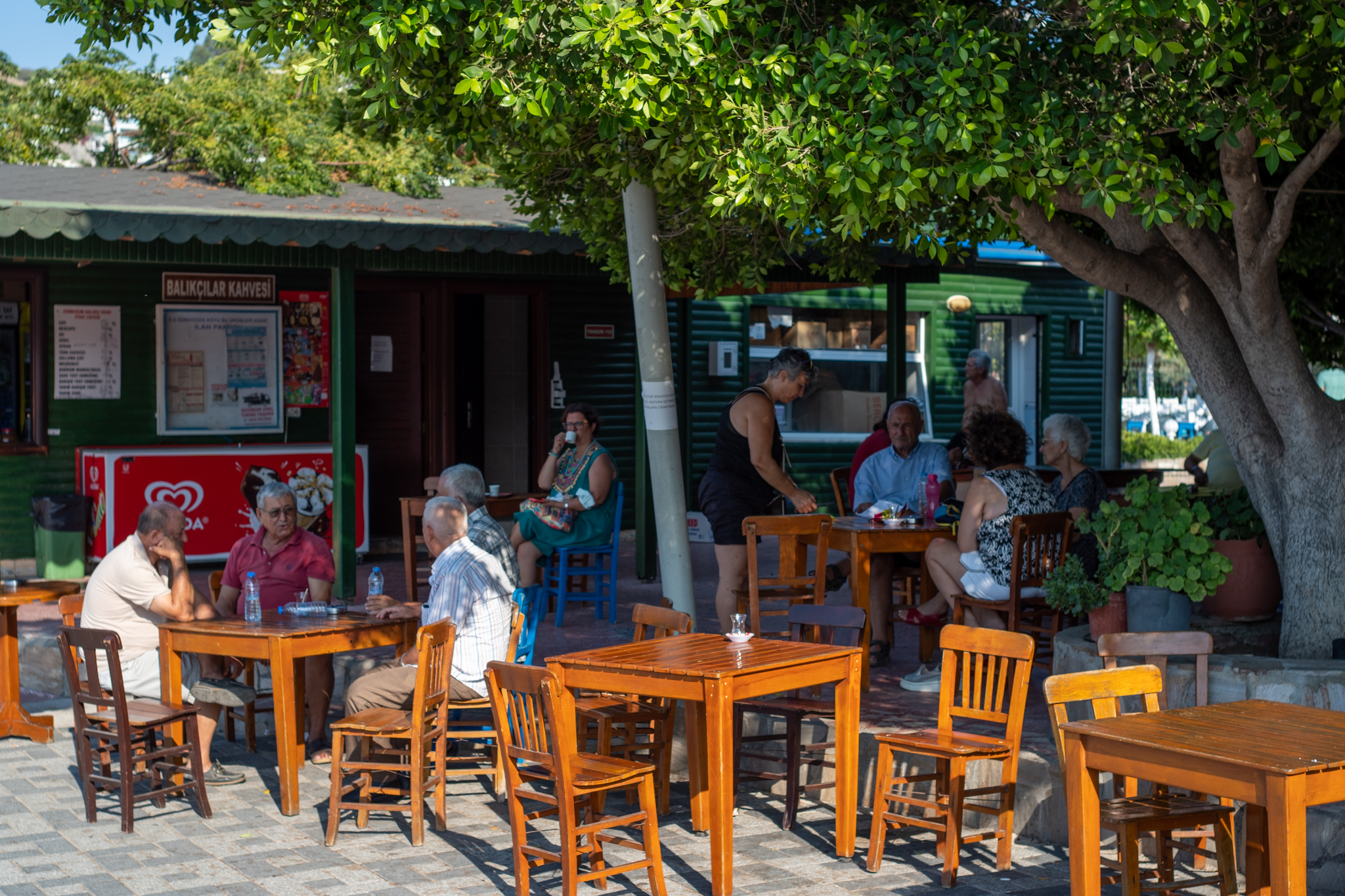
The Fishermen’s Coffee House

It is a late afternoon in August, a pleasant breeze is strolling around the fishermen’s harbour. 

I am in Gündoğan, sitting at a table under the shade of trees with thick canopies that belong to an outdoors coffee house. 

It wasn’t crowded. Retirees, men and women, and fishermen, sparsely occupy tables. They are having tea or coffee. Coffee is served with ice cold water at the side, served in small paper cups. 

The estate is made of a small cottage that belongs to the Fishermen’s Cooperative. 

In past years this place had been a more traditional type of Turkish Coffee house, with waiters running around to serve patrons. 

During covid years they introduced self service. I think this works better, as it feels cleaner and simpler. 

There is no TV, nor music, nor plastic chairs. It has authenticity, good old wooden tables and chairs, a lovely garden and a young black cat. 

A woman is managing the estate, couple of teenagers are assisting her. 

The atmosphere is civilised and peaceful. There is this slow movement, a sense of being part of a community around me. Retirees and fishermen are chatting in low voices as shades of trees grow taller. 

In front of me I see a long line of boats docked, fishermen are mending their nets. The sun, loosing its battle, begins to set behind western hills. 

While Turkish flags are waving on every boat, the sunlight is filtered through them, making reds stand out. 

I cannot help to think this must be the best place on earth right now. As if I am teleported to 50 years earlier, a naive but more peaceful world where things are taken easy.

Friday, August 5, 2022

The minibus to Gündoğan

 It was a hot August morning.

The minibus was turning sharp curves of the narrow winding road like a raging bull. 

Giant cacti and bougainvillea were sprawling on hills where white houses with blue frames were scattered. 

In the minibus, retirees, tourists, and kids were travelling from their houses to downtown Gündoğan. 

The driver was a soft spoken man with blue eyes. 

Occasionally he had to press a button to reset the ticket reader mounted on a pole next to the passenger door. 

Commuters who had blue plastic cards held them against the machine, but sometimes it malfunctioned, forcing the driver reset it. 

To the driver’s and passengers’ dismay, resetting the reader took long time, with an animated hourglass appearing on the screen, creating anxiety among passengers entering the bus. 

Almost everyone had an opinion about the ticket reader. 

“It’s not reading, can you reset it again?” cried one woman, her voice muffled by a face mask, holding a large beach bag on her shoulder. 

“Is there anything we (Turks) do that works?” protested another one. 

The minibus took a left turn and entered a straight street shaded by tall needle pine trees. After a minute’s drive it entered the terminal area where it stopped. 

Passengers raced to get out, almost toppled out of the minibus, took their face masks off in relief as if surfacing from a deep sea dive.

Monday, August 1, 2022

Remains of the day

 When the sun leaves us with fleeting lights, and fireflies sing in melancholy, we need to reflect. 

No regrets from past should flow into this moment, nor we should let worries of tomorrow spoil it. 

This magical light, here and now, is ours. 

Sunday, July 24, 2022

Nature’s solutions

 23 July 2022

There is a vacant land next to the apartment we live in Ankara. 

In the past there was no livelihood on it. People dumped rubbish there. Once there were big piles of used planks. Packs of stray dogs claimed it their territory, endlessly barking at night to defend it. 

We haven’t visited the apartment for three years. This year a pleasant surprise was awaiting us. 

We were told there was extraordinary rainfall in Ankara during springtime and early summer. 

As a result the land was covered with shrubs and thorny bush that have beautiful blossoms. I saw butterflies and birds. 

Nature claimed the land in a profoundly meaningful way. 

This evening I was walking around the land, and noticed how big the thorns were. It must now be impossible for humans or dogs to enter the area. 

When left alone, Mother Nature looks after herself. 

Thursday, July 21, 2022

First impressions

18 July 2022, Ankara

The flight QR 313 from Doha to Ankara landed on Esenboğa Airport  before noon on a mild summer day. 

I loved this airport. It has a non pretentious, specious and functionally oriented modern architecture. Yet this time, after 3 years of Covid break, something was amiss. 

Inside the terminal it wasn’t crowded. I noticed lights were dimmed and the air was thick. I assume this may be a cost cutting measure amid the most recent economic crisis. 

I had an arduous 20 hours trip from Australia. I had acute sciatic pain and stomach pain that deprived me from sleeping, nor I could occupy my mind with other forms of distractions. 

When the plane landed I was exhausted, and I felt an immediate need to visit toilets. 

Fortunately the passport queue ran off quickly, the new passport image recognition software worked and the hunt for toilets could begin. 

After dragging along suitcases and bags along endless corridors for what felt like eternity, from a distance I recognised the most welcoming icon after McDonald’s, the featureless man and woman, the universal symbol of toilets. 

Inside, there were two closed cubicles, both of which were occupied. I was lucky, there was one man in front of me, and a long queue was forming rapidly behind me. The waiting felt like ages, and in my mind I have began to go through dire what-if scenarios, none being remotely dignifying. 

Oh the sweet sound of the toilet cubicle lock. A man was out, there was barely any smell, a clean toilet at last. 

I emerged as a new man from the toilet. You know the feeling; you could do anything, discover an exoplanet, climb the Everest or swim the Atlantic. 

As I took the escalators to the baggage collection area, I noticed I had visited the only toilet between the airplane and the baggage carousel, a terrifying realisation in hindsight.  

Once I collected my luggage, I was surprised to find a check point on the way out. For decades you could leave the terminal without your luggage checked. 

There was no queue lanes, hence the passengers formed a funnel shaped hive, its outlet reaching a security checkpoint. 

What stroke me was the grim facial expressions of custom officers. The country’s official inflation rate is now 78%. You can read the economic hardship from groceries price tags and sad faces. 

The custom officers were acting strangely though. Despite their sad outlook, they weren’t hostile nor they were picking on luggage as they normally should. They were indifferent as if they took part in a passive strike, or participated a silent protest. 

I took my luggage, got out to fresh air and headed to a taxi. 

Sunday, June 12, 2022

Perfect to ride around Balmain

Sitting outside a rustic Balmain cafe at kerb washed by setting winter sun, I noticed the key was left on a Vespa scooter.


My thoughts drifted to a past world of tranquility when things were different. People had time for each other, doors were left open, keys were left on ignition. 

The world has always been raged by misery induced by war, pestilence, greed or depravity. But we maintained “pockets of resistance” reminiscent of good old days that spirit of humans persisted. 

Sometimes it helps to leave current affairs afar. Self reflection may not always be easy during daily grind of news and chores, but when we seize the chance we should seek light and reflect. It doesn’t cost anything if we allow being generous to ourselves and leave sparkles here and there. 

The rider of the Vespa returned with take-away in one hand. He placed them in the boot. We exchanged glances, and I asked,

- Do you enjoy riding Vespa?

He smiled and said:

- Perfect to ride around Balmain.

Saturday, January 22, 2022

Teddy's legend

 “When all else fails, hug your Teddy” the urban legend goes. 


Teddy represents many things all at once. Albeit being lifeless, they consoled us when we faced our first frustrations in life. They were our first friends to hold our first conversations with.

But in another sense Teddy represents our insecurities. It shows, we are vulnerable creatures in need for consolation and friendship.

I like looking at windows of charity establishments like Vinnies Shops. These are like museums, time capsules facing public kerbs. 

Every object behind the window represents something from the past and discarded. 

When I saw “Teddy in a sack” it resonated sadness in me. It recalled perhaps we are ungrateful as much as needy. In that sense the humble Teddy acts as a messenger to remind us our inner conflicts.

Wednesday, January 5, 2022

Metaverse

Metaverse is not a brand new idea. There was Second Life, an online multimedia platform that came about in 2000s, developed and owned by Linden Lab.

These are virtual reality products designed to capitalise on your time, in return of what they call an “immersive experience”. It is worth to note, unlike video games “there is no manufactured conflict, no set objective” in them.

I watched Mark Zuckerberg’s vision for socialising in the Metaverse video. Under his tight black sweatshirt and denim, a paunch appeared. He seemed to have lost his boyish college dropout edge. With a frozen smile he now looks more like a James Bond villain or a wax model in Madame Tussauds. Something is amiss, loss of spark maybe.

The possibility of meeting your grandchild’s 3d avatar rather than seeing them in a Zoom meeting, or sharing your 3D art in a virtual street corner, may sound attractive to some. But like Elon Musk, I doubt anyone would be willing to wear a TV set on their nose just to play poker with their friends’ avatars.

We have to acknowledge virtual reality hardware technology is still in its infancy. It is too bulky and invasive, setting significant barriers against immersive experience.

But even if we assume technological setbacks are temporary and one day we might wear contact lenses and just whisper to teleport ourselves into the VR world, would you want that?

Metaverse tells us, If you fail to realise your dreams, don’t worry, you can wear your headset and become “who you want to be” in a virtual world. You can create as many avatars you can, Zuckerberg said. It will be entirely in your control whom you want to interact with. 

The chances are, you will go back to your Facebook friends. 

Rest assured once you open your mouth you will be the same person to anybody who knows you or about to know you regardless you wear Genghis Khan, Einstein, Jane Mansfield, or T-Rex avatars.

Maybe you wouldn’t be sweating in a bunny suit but the glorification you will get will not be much different from being in a fancy dress party. The entertainment sensation will wear out in minutes. In the end you will look and feel pathetic, rather than authentic.

Then there is the experience bit. Supposedly you would be able to hang out with your friends in different environments, a street in Milan, a villa in Switzerland and so on.

But would you invite your high school friend whom you haven’t seen for 30 years to a backgammon tournament on the banks of River Seine?

Or would you do or talk about anything different even with your favourite buddy whether you are virtually hiking in Iceland or virtually flying across NYC? What are you going to talk about? Oh, look at this virtual pink volcano?

By the way your “immersive” hiking experience over Iceland may be interrupted with an advertisement tailored for you; environmentally friendly toilet paper packaged in a card box sliding on slopes of black ash. 

Perhaps you should be grateful and think about Mark Zuckerberg when you use that square.

Friday, December 31, 2021

Kirribilli Gothic

 It is rare that I see a low hanging fruit like this and get excited about it. The frame in my mind had all elements of a good story. 


A building with a certain air, mysterious and nonconformist, as if an affluent person lived in 1920s, someone like The Great Gatsby, was looking down on me. There was a Christmas tree thrown on the sidewalk opposite to the entrance.  

The plants on terraces stood with eerie presence. I could not help but thought the Christmas tree was not welcome there, and the plants domineered their owners so that they had no option but get rid of the tree.

Inspirations: